

Dr. Daniel J. Cutler (Marie SkłodowskaCurie Actions Global Postdoctoral Fellow
LabMolDesign / Rawson Group ; Universitat de Barcelona / University of Windsor )
Résumé : The field of molecular magnetism focuses on the development of magnetic materials by the utilization of the so-called “bottom-up” approach, using paramagnetic building blocks to prepare new materials with desirable magnetic properties.1,2 Some common choices of building blocks include transition metal (TM) and lanthanide (Ln) ions, and open-shell radicals. The combination of these starting materials into different architectures can tune the magnetic properties of the material to afford sought after magnetic properties ranging from slow magnetic relaxation dynamics, spin crossover behaviour, magnetic frustration and high-spin bearing species. This seminar will present work based on two themes, TM and Ln coordination cluster chemistry and main group thiazyl radical chemistry.
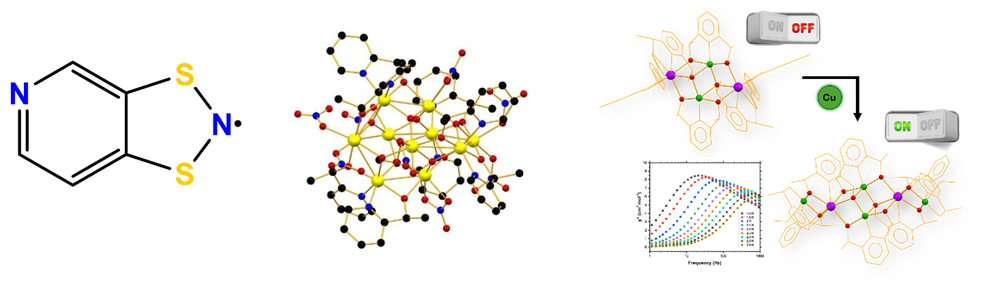
Polymetallic coordination clusters are some of the most well studied magnetic molecules with the dodecametallic Mn12-acetate cluster being the first reported Single Molecule Magnet (SMM).3 Here we present work building cluster compounds with TM ions (CuII and FeIII) and Ln ions (DyIII, TbIII and GdIII) using flexible pyridyl alkoxide ligands. The CuIILnIII butterfly system displays a “switching on” effect where the addition of auxiliary un-paired spins, in the form of CuII, switches on the slow magnetic relaxation of the molecule. Work with FeIII ions focuses on the effects on cluster preparation when using chiral vs racemic chelates. We report a family of six cluster compounds ranging from a simple Fe2 dimer to a Fe10 decamer.
Main group thiazyl radicals have proven to be promising candidates for designing tuneable magnetic materials. To date work with these radicals have afforded material with properties varying from canted anti-ferromagnetism,4 single molecule magnetism5 and spin crossover.6 The 4- pyDTA radical, presented, displays hysteric spin crossover behaviour in the solid state as a result of a first order phase transition. Investigations with variable temperature EPR, magnetometry and XRD methods elucidate the nature of this transition
References:
1.- M. B. Duriska, S. M. Neville, B. Moubaraki, J. D. Cashion, G. J. Halder, K. W. Chapman, C. Balde, J.-F. Létard, K. S. Murray, C. J. Kepert and S. R. Batten, Angewandte Chemie International Edition, 2009, 48, 2549–2552.
2.- S. Sanz, H. M. O’Connor, E. M. Pineda, K. S. Pedersen, G. S. Nichol, O. Mønsted, H. Weihe, S. Piligkos, E. J. L. McInnes, P. J. Lusby and E. K. Brechin, Angewandte Chemie International Edition, 2015, 54, 6761–6764.
3.- H. J. Eppley, H.-L. Tsai, N. de Vries, K. Folting, G. Christou and D. N. Hendrickson, Journal of the American Chemical Society, 1995, 117, 301–317.
4.- D. Leckie, M. Harb, N. Mroz, J. D. Wrixon, J. Campo, A. Arauzo, H. Bakhshi, M. Pilkington and J. M. Rawson, J. Am. Chem. Soc., 2024, 146, 31371–31376.
5.- E. M. Fatila, M. Rouzieìres, M. C. Jennings, A. J. Lough, R. Clérac and K. E. Preuss, Journal of the American Chemical Society, 2013, 135, 9596–9599.
6.- W. Fujita and and K. Awaga, Science, 1999, 286, 261–262.

Prochains évènements
Retour à l'agendaSéminaire DCMI présenté par : Martin SAROTT
Titre : Tailoring Domain and Domain-Wall Properties of Epitaxial Ferroelectricand Ferroelastic Thin Films Using Strain, Electrostatics, and Light