

Thème : Chemical engineering of hybrid and activable mesoporous silica platforms for theranostic applications. (D. Mertz)
We will discuss the animation and organization of Axis 2 and the events to be planned.
Thème : Chemical engineering of hybrid and activable mesoporous silica platforms for theranostic applications. (D. Mertz)
We will discuss the animation and organization of Axis 2 and the events to be planned.
Speaker: Antti Moilanen, ETH Zurich
The abstract is available there.
Pr. Neso Sojic (Institut des Sciences Moléculaires, Université de Bordeaux)
Abstract : https://www.ipcms.fr/uploads/2025/01/Abstract_NesoSOJIC.pdf
Speaker: Laetitia Farinacci, Institute for Functional Matter and Quantum Technologies – University of Stuttgart
The abstract is available there
Benjamin BACQ-LABREUIL (IPCMS – DMONS)
Abhishake MONDAL (Solid State and Structural Chemistry Unit, Indian Institute of Science, Bangalore)
Abstract :
The pursuit of smart multifunctional materials with stimuli-responsive magnetic and optical response has drawn escalating interest in both fundamental science and potential applications to switches, sensors, and intelligent devices.1 One of the appealing feature of such materials is the tunability of their physical property via chemistry, where the linking structure and physical properties can be modulated in practically infinite ways, which gives them an edge over the solid-state magnetic materials (Figure 1, a).2 The field of molecular bistable systems is rapidly budding towards utilizing these molecule-based magnetic materials in physics-driven and nanotechnology-driven fields (Figure 1, b).
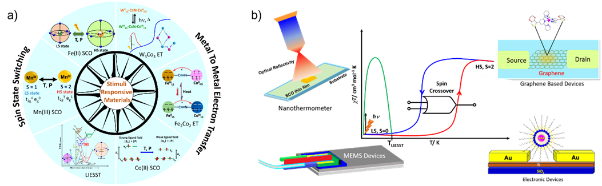
Figure 1: a) Stimuli-responsive molecular bistable systems and b) Application areas where these systems are actively studied for developing devices
Here, I will briefly cover the exciting field of Molecular Magnetism and will specifically focus on three most important aspects of Molecular Magnetism being pursued in my laboratory i) Spin Crossover (SCO) materials3 ii) Metal-to-Metal Electron Transfer Systems (MMET)4 and iii) Single Molecule Magnets (SMM).5 Lastly, I shall discuss the application of these bistable systems in developing ring-resonator devices for Photonics Application, molecular break junctions and microelectromechanical systems.
Acknowledgments: I thank the Indian Institute of Science (IISc), Bangalore, India, and the Ministry of Human Resource Development (MHRD), Ministry of Education (MoE), Government of India, IISc-Start-up Research Grant, the Department of Science and Technology, Mission on Nano Science and Technology (Nano Mission), Scheme for Transformational and Advanced Research in Sciences (STARS, MHRD), Council of Scientific and Industrial Research (CSIR) for the research fundings.
References:
1. Kamilya, S.; Dey, B.; Kaushik, K.; Shukla, S.; Mehta, S.; Mondal, A. Chem. Mater. 2024, 36, 4889, Kaushik, K.; Mehta, S.; Das, M.; Ghosh, S.; Kamilya, S.; Mondal, A., Chem. Commun., 2023, 59, 13107, Coronado, E., Nat. Rev. Mater. 2020, 5, 87. 2. Minguez Espallargas, G.; Coronado, E., Chem. Soc. Rev. 2018, 47, 533. 3. Ghosh, S.; Kamilya, S.; Pramanik, T.; Rouzieres, M.; Herchel, R.; Mehta, S.; Mondal, A., Inorg. Chem. 2020, 59, 13009, Ghosh, S.; Ghosh, S.; Kamilya, S.; Mandal, S.; Mehta, S.; Mondal, A., Inorg. Chem. 2022, 61, 17080, Bagchi, S.; Kamilya, S.; Mehta, S.; Mandal, S.; Bandyopadhyay, A.; Narayan, A.; Ghosh, S.; Mondal, A., Dalton Trans., 2023, 52, 11335, Ghosh, S.; Bagchi, S.; Kamilya, S.; Mehta, S.; Sarkar, D.; Herchel R.; Mondal, A., Dalton Trans., 2022, 51, 7681. 4. Kamilya, S.; Ghosh, S.; Li, Y.; Dechambenoit, P.; Rouzières, M.; Lescouëzec, R.; Mehta, S.; Mondal, A., Inorg. Chem., 2020, 59, 11879, Kamilya, S.; Ghosh, S.; Mehta, S.; Mondal, A., J. Phys. Chem. A 2021, 125, 4775. 5. Hossain, S. M.; Kamilya, S.; Ghosh, S.; Herchel, R.; Kiskin, M. A.; Mehta, S.; Mondal, A., Cryst. Growth Des. 2023, 23, 1656.
Program :
09h00-09h30: Iann Gerber (LPCNO Toulouse)
Theoretical exploration of exciton-exciton interactions in 2H-transition metal dichalcogenide bilayers
09h30-10h00: Vincent Jacques (L2C, Montpellier)
Quantum sensing with spin defects in hexagonal boron nitride
10h00-10h30: Coffee break
10h30-11h00: Clément Faugeras (LNCMI, Grenoble)
Magneto-Raman scattering of a frustrated van der Waals magnet
11h00-11h30: Cyriaque Genet (ISIS, Strasbourg)
Taming a Maxwell’s demon for experimental stochastic resetting
The abstracts are available there.
Speaker : Pr. Keiichi INOUE (Functional Materials Group, The Inst. for Solid State Physics, University of Tokyo)
Rhodopsins, or retinal proteins, are light-sensitive membrane proteins, with very important biological functions. In vertebrates, rhodopsins are the sensors for vision.
Pr. Inoue is a world-leading expert in the photochemical studies of microbial retinal proteins (https://www.icpworldcongress.com/keiichi-inoue). His research aims at a detailed molecular understanding of how the different biological functions of these rhodopsins are encoded in the structural and spectroscopic properties. The abstract can be found : here
Contact: Stefan Haacke (stefan.haacke@ipcms.unistra.fr)
Speaker: Clément Pellet-Mary, University of Basel, Switzerland
The abstract is available there.
Speaker: Cyrille Solaro, CESQ, Strasbourg
The abstract is available there.