The ADDEPT will organize a meeting where all postdocs of the lab are invited to share their “final push” experiences as former 3rd year PhD, tell about what they did wrong, what to be careful at, what they would do differently, useful tips, to the actual 3rd year PhD students of the lab (2nd year are also welcome). It will take the form of a 2hours (at most) free, respectful and kind discussion.
This meeting will take place on Wednesday 21st February, from 4p.m. to 6p.m., at the IPCMS cafeteria.
Dr. Laurence CROGUENNEC (Institut de Chimie de la Matière Condensée de Bordeaux)
Directrice de recherche CNRS, directrice adjointe de l’ICMCB
Abstract :
Known from all chemists for decades, the sodium-ion battery technology was dethroned in the 1980s by the lithium-ion battery that offered better performance. The major interest of sodium is to be a sustainable resource in comparison to lithium. The technology is thus back on the scene as an ecological, economical and reliable alternative to the lithium-ion battery. I will present the challenges of this research field, and highlight some of our results. I will show how we were able to (i) discover a new family of NASICON structural type materials NaxV2(PO4)3, and (ii) demonstrate how the chemistry of mixed anions and in particular the competition between the ionic bond V-F and the very covalent vanadyle-type bond V=O has an impact on the properties of Na3V2(PO4)2F3-yOy. I will demonstrate that only the in-depth control of the relationship synthesis/composition/atomic and electronic structure allows to tune the properties in the battery. I will illustrate also that monitoring in situ and operando, especially at large scale facilities, the synthesis of electrode materials and their evolution when used in batteries is essential. Changes in the composition and structure of the materials must be studied in their environment (in situ), and in real time (operando) during their preparation or operation of the battery because they are most often in conditions out of equilibrium. The experiments thus conducted allow to study the dynamics of reactions, essential for the understanding of the material and optimization of its performance in the electrochemical storage system.
You are all welcome to attend, as this 1h meeting will be followed by a small “pot” (drink and snack) at the cafeteria. You will learn a bit more about us, be able to ask questions or make suggestions, and have also the possibility to join the ADDEPT as a permanent member if you wish so! By the way, we are actually recruiting new permanent members! So feel free to join (it’s free and fun)!
You will be able also to renew (or start) your ADDEPT membership on that same day, in order to get discount on our 2024 events. Membership fees are still 10euros for permanent members of the lab, 5euros for PhD and postdoc.
ADDEPT general assembly will be followed by the savouring of the famous and traditional “galette des rois”
Looking forward to seeing many of you there,
Contact : Xavier Henning
Florence GAZEAU (MSC Med Lab and IVETh integrator , 45 rue des Saints Pères, 75006 Paris, France)
Abstract : The clinical use of extracellular vesicles (EVs) will progressively become a reality in view of the number of ongoing clinical trials worldwide harnessing EV potency for tissue healing, resolution of inflammation (notably in Covid 19 patients), vaccination, drug delivery or cancer therapies, among others. EVs, encompassing a variety of cell shed nanoscale membrane vesicles (exosomes, ectosomes, microvesicles, OMV from bacteria…), are released by all cell types, either spontaneously or after induction, and circulate in all body fluids playing an active role in many physio- and pathological processes. EVs contribute to intercellular communication and immunomodulation via delivering bio-molecules like nucleic acids, proteins, and lipids that modify the recipient cells. Numerous biological effects of cell therapy rely on the cells’ secretome and, in particular on biomolecules contained in EVs, which are now studied as potential therapeutic agents to recapitulate a substantial part of the parental cell’s benefits, especially for stem cell-derived EVs. However the clinical translation of EV-based biotherapies face numerous challenges such as cost-effective large scale bioproduction compatible with a clinical use (GMP manufacturing), reproducibility from one batch to another and difficulties to isolate, characterize and identify the most potent nanosized subfractions from a complex and heterogeneous cell secretome. In addition, the technologies to engineer EVs in a pre-production or post-production step to convey specific proteins, nucleic acids, drugs and nanoparticles and improve or control their specific targeting and therapeutic activities are still in their infancy. In this presentation, we will present the breakthrough technologies for high throughput bioproduction, engineering and multimodal IA-assisted characterization of therapeutic stem cell-derived EVs, as well as EV delivery, that have been developed in our lab and led to the creation of two spin off. These technologies, based on multidisciplinary and physics-powered approaches (turbulence approach for high yield high throughput EV bioproduction and loading, EV delivery in a carrier gel, multimodal analysis tool box) are available for the industrial and academic partners on our innovation hub IVETh (https://iveth.u-paris.fr/) labelized as a national industrial integrator biotherapy-bioproduction in 2022
Speaker : Amélie JUHIN (Institut de Minéralogie, Physique des Matériaux et Cosmochimie (IMPMC). CNRS-Sorbonne Université)
Abstract : X-ray spectroscopies performed at synchrotron light sources, such as X-ray Absorption Spectroscopy and Resonant Inelastic X-ray Scattering are powerful tools to study complex materials, due to their chemical selectivity that allows disentangling the respective contributions of different atomic species. In this talk, I will show how the use of incident polarized x-rays (either linear or circular) can allow a deeper understanding of the electronic structure and reveal emergent properties, with a focus on remarkable magnetic nanomaterials: Single Molecule Magnets, bimagnetic nanoparticles, ferrofluids, ultra-thin nanowires. Moreover, I will illustrate how the combination of these spectroscopies with x-ray microscopy can provide valuable information with nanoscale spatial resolution, exemplified by recent results obtained on magnetotactic organisms.
13:00 – 13:30 : Prof. Yusuke Noda (Okayama Pref. Univ.)
Stability analysis of large-scale defects in Si using machine learning interatomic potential
13:30 – 14:00 : Prof. Tokuhisa Kawawaki (Tokyo Univ. Sci.)
Synthesis and catalytic properties of ligands-protected metal clusters
14:00 – 14:30 : Prof. Masato Nakaya (Nagoya University)
STM/STS Characterization of Thermally Stable Array of Discrete Fullerene Molecules formed on a Two-Dimensional Nanospace Adlayer of Macrocycles
14:30 – 15:00 : Prof. Ayae Narutaki (Nagoya University)
Design and application of protein nanofibers
15:00 – 15:30 : Coffee break
15:30 – 16:00 : Prof. Jun Onoe (Nagoya University)
Recycling of precious metals using nanospace materials
16:00 – 16:30 : Dr. Senthil Kuppusamy (INT-Karlsruhe Institute of Technology)
Coherent light-matter interfaces based on luminescent Eu3+ complexes
16:30 – 17:00 : Prof. Florian Banhart (IPCMS, Univ. Strasbourg)
Photoswitchable materials and fast chemical reactions in nanocrystals studied by ultrafast electron microscopy
17:00 – 17:30 : Patrick Lawes (IPCMS, KIT)
Non-sublimable molecules deposited by Electrospray Controlled Ion-Beam (ESI-CIBD) and probed by STM.
The meeting will take place in the IPCMS’ Auditorium and via BBB. Link : https://bbb.unistra.fr/b/cob-lyy-20x-t6l
Contact : Noémi Cobolet, chargée de mission science ouverte de l’Université de Strasbourg: openaccessmonth[at]unistra.fr
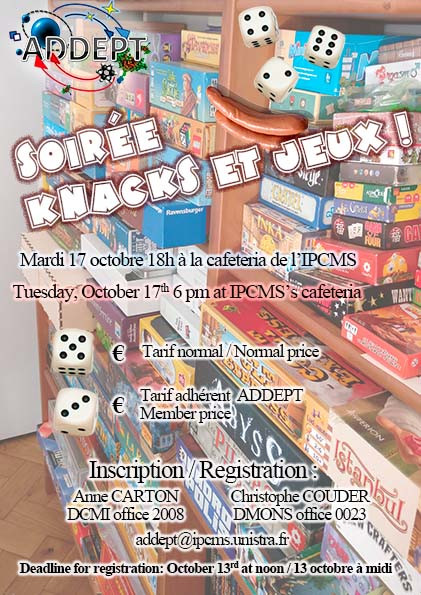
On the program, small games during the aperitif: chips/beers/soft drinks. Then on the menu, knacks and potatoes salad and slightly longer games, ice cream and fruits for dessert. Veggie and vegan option will be proposed as well. Do not hesistate to bring your own favorite games with you and to make them us discover! In any case, a selection of boardgames will be at your disposal and we will take the time to explain you their rules. Happiness and friendliness will be the words of this event !
Participations fees are of 5 euros, or 3 euros if you are ADDEPT members (possibility to get the membership card during registration)
We are looking forward to playing with you!