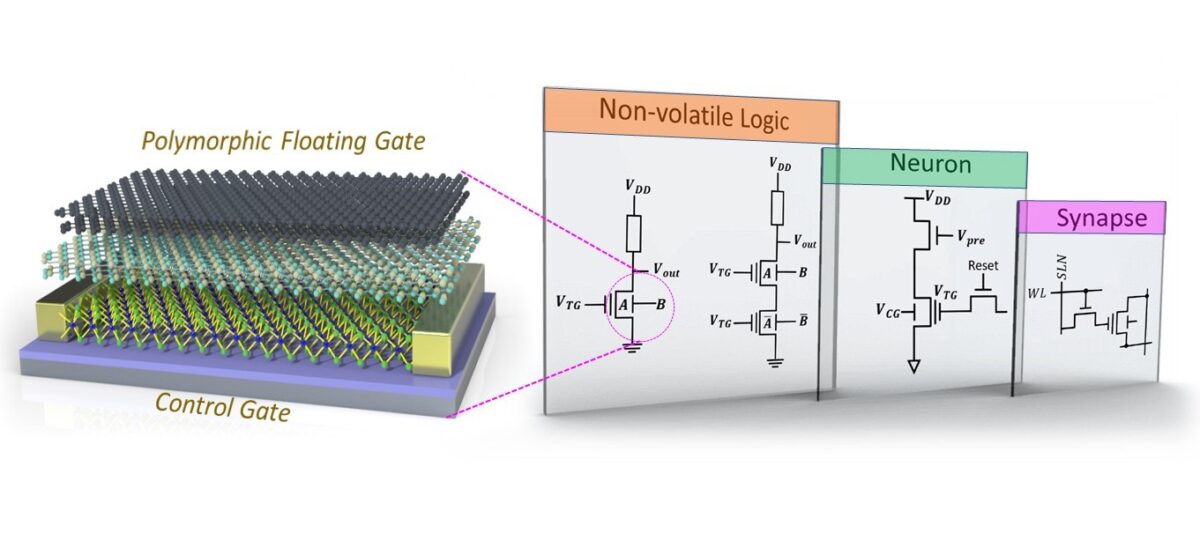
A floating gate topology  for agile Artificial Intelligence circuits

As the miniaturization of traditional silicon-based electronics nears its physical limits, the semiconductor industry faces mounting challenges: energy inefficiency, data bottlenecks in von Neumann architectures, and inflexible hardware for AI-driven tasks. Emerging applications like autonomous systems, IoT, and real-time learning demand a radical shift in how computation and memory are integrated at the nanoscale.

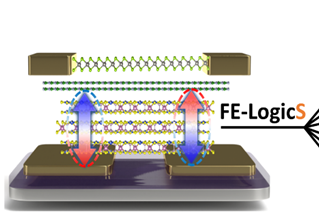
Developed by an international consortium of leading institutions including Université de Strasbourg, Institute of Nanotechnoly of Lyon, Université Paris-Saclay, and the National Institute for Materials Science (Japan), we are excited to present a new achievement in nanoelectronics: The Van der Waals Inverted Floating Gate Field-Effect Transistor (IFGFET) — a novel device topology that bridges logic, memory, and neuromorphic computing in a single architecture.

This innovation leverages Van-der-Waals heterostructures, combining ReS₂ semiconductors with a top polymorphic floating gate and a bottom control gate. This topology makes it possible to access the floating gate and leads to a better electrostatic control of the channel compared to the traditional topologies.

In addition, this technology provides game changing features such as:

  • Dual-mode functionality: Operates as a reconfigurable logic gate and a non-volatile memory element.
  • Neuromorphic capabilities: Emulates synaptic behavior with 92% ANN accuracy and supports spiking neuron circuits.
  • Compact and secure design: Enables on-demand, programmable AI circuits with inherent data security through self-erasing memory.
  • Enhanced electrostatic control: Inverted topology boosts performance compared to conventional FGFETs by optimizing gate-to-channel coupling.

This reconfigurable device may unlock new frontiers in in-memory computing, neuromorphic and spiking neural network, and secure AI hardware.

👉 Read the full article in ACS Nano: Link to article

Contact :   dayen@unistra.fr
Nickelates: a stabilised superconducting state without doping

Read the news online on the CNRS CHIMIE website (in french only)

Réference : Hoshang Sahib, Aravind Raji, Francesco Rosa, Giacomo Merzoni, Giacomo Ghiringhelli, Marco Salluzzo, Alexandre Gloter, Nathalie Viart, Daniele Preziosi
Superconductivity in PrNiO2 infinite-layer nickelates
Advanced Materials 2025 
https://doi.org/10.1002/adma.202416187

Contact : Daniele Preziosi (Chercheur à l’Institut de physique et de chimie des matériaux de Strasbourg (CNRS/Université de Strasbourg) daniele.preziosi@ipcms.unistra.fr

Des taxis à protéines

“CORELMAG” fait partie des projets ANR 2019 : Nanocomposites innovants libérant des facteurs biologiques par hyperthermie magnétique en tant que composants de matrices intelligentes pour l’ingénierie tissulaire.

Coordinateur du projet : Damien MERTZ (IPCMS – DCMI)

Vous pouvez lire ou télécharger la BD sur cette page : https://www.alsace.cnrs.fr/fr/corelmag

Initiative portée par le service communication Alsace du CNRS.

Programme d’accompagnement à la médiation scientifique : Sophie Le Ray

Planche de bande-dessinée réalisée par Camille Van Belle

Towards photochemistry on a sub-molecular scale

The article recently published in Nature Nanotechnology (Doi : 10.1038/s41565-024-01622-4): Submolecular-scale control of phototautomerization / Anna Roslawska, Katharina Kaiser, Michelangelo Romeo, Eloïse Devaux, Fabrice Scheurer, Stéphane Berciaud, Tomas Neuman and Guillaume Schull, is the subject of a news item on the CNRS Physique website.

https://www.inp.cnrs.fr/fr/cnrsinfo/vers-une-photochimie-lechelle-sub-moleculaire

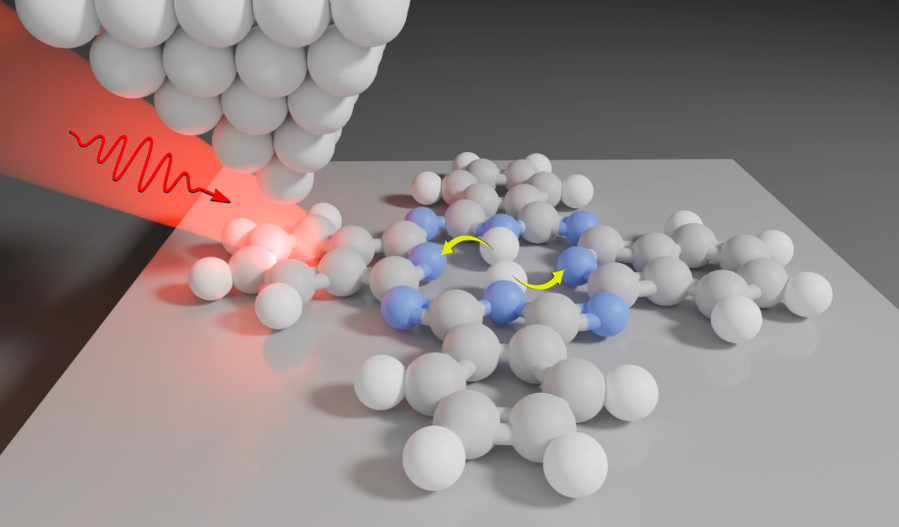
Figure : Contrôle local de la réaction de photo-tautomérisation de la phtalocyanine. La pointe métallique est visible dans la partie supérieure gauche de la figure © A. Rosławska et G. Schull.

Two-dimensional ferroelectric devices are revolutionizing the topology of integrated circuits

An international consortium (University of Strasbourg, University of Luxembourg, NIMS Japan, Ecole Centrale Lyon, C2N Saclay) led by IPCMS (team of Jean-François Dayen, DMONS), established the concept for a new generation of reconfigurable ferroelectronic logic circuits.

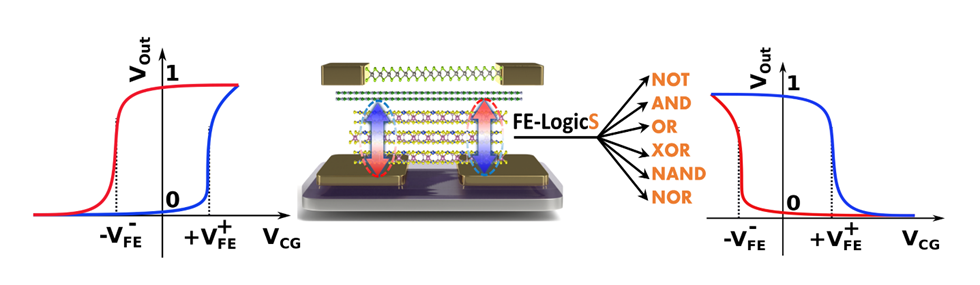
These devices, referred as Re-FeFET, allow for encoding and manipulating the information in a single operating unit, circumventing the famous ”Memory Wall” limitation of modern CMOS technology.  By making use of the switchable polarization state of two ferroelectric gates, the electrical potential landscape within a semiconductor channel can be permanently and reconfigurably modified. Depending on the ferroelectric state encoded, the ferroelectric logic circuits can function as six alternative logic gates, while CMOS circuit are limited to a single function. Last but not least, the device can operate as a photodiode and generate photovoltaic energy. These findings rethink circuit topology and memory-logic interaction, opening up new research directions in the area of frugal computational enhancement.

Reference :
Reconfigurable Multifunctional van der Waals Ferroelectric Devices and Logic Circuits
Ankita Ram, Krishna Maity, Cédric Marchand, Aymen Mahmoudi, Aseem Rajan Kshirsagar, Mohamed Soliman, Takashi Taniguchi, Kenji Watanabe, Bernard Doudin, Abdelkarim Ouerghi, Sven Reichardt, Ian O’Connor and Jean-Francois Dayen.
ACS Nano 2023, 10.1021/acsnano.3c07952.  Link.

Schematic of a reconfigurable ferroelectric device, based on van der Waals materials, that can operate several logic functions within a single circuit.

Contact : Jean-Francois Dayen

Read the article on the website : CNRS – Physique

Références

Reconfigurable Multifunctional van der Waals Ferroelectric Devices and Logic Circuits, Ankita Ram, Krishna Maity, Cédric Marchand, Aymen Mahmoudi, Aseem Rajan Kshirsagar, Mohamed Soliman, Takashi Taniguchi, Kenji Watanabe, Bernard Doudin, Abdelkarim Ouerghi, Sven Reichardt, Ian O’Connor et Jean-Francois Dayen, ACS Nano, publié le 21 octobre 2023.
Doi : 10.1021/acsnano.3c07952
Archives ouvertes : HAL

Des hétérostructures ferroélectriques contrôlées par la lumière pour l’électronique neuromorphique

Une part importante des efforts de recherche en technologies de l’information essaie de contourner le goulot d’étranglement entre processeur et mémoire. Le premier doit travailler de plus en plus vite et manipuler toujours plus de données, alors que la vitesse d’échange avec les composants mémoire est limitée. Ainsi, les processeurs de nos ordinateurs passent une grande partie de leur temps à attendre… Une stratégie de recherche consiste à explorer des technologies « non-Von Neumann », orthogonales à cette architecture classique qui atteint ses limites.

Pour cela, une voie possible est celle des puces neuromorphiques, visant à s’inspirer des réseaux de neurones biologiques. Cette technologie, dite ‘In-memory computing’, permet d’exécuter à la fois des calculs et le stockage mémoire, au sein d’un même composant.

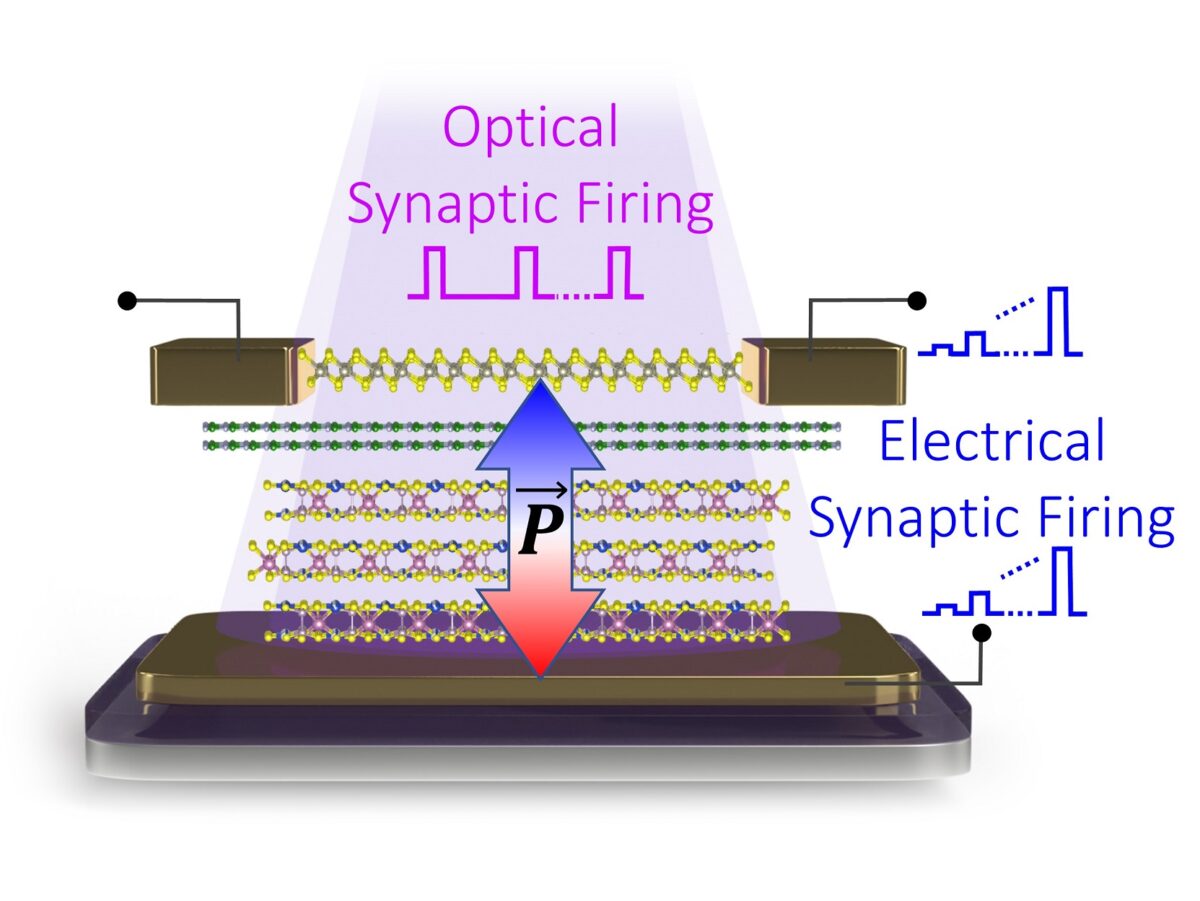
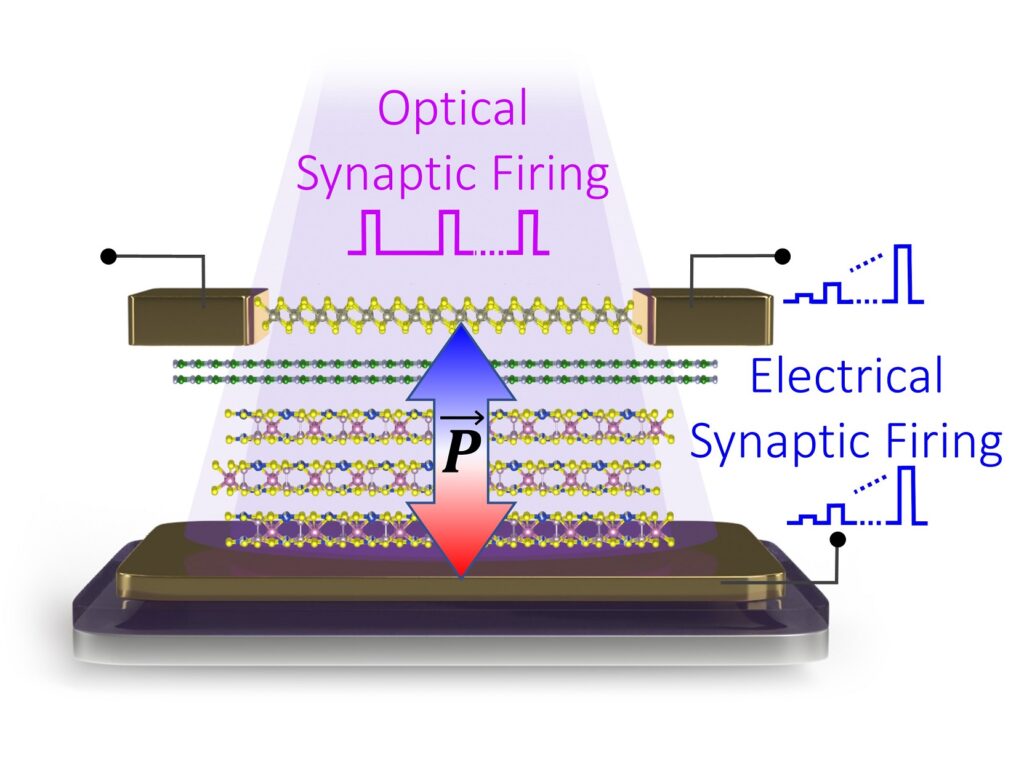
      L’équipe  Nanodevices de l’IPCMS, en collaboration avec le C2N (Saclay), vient de démontrer qu’une telle technologie neuromorphique pouvait être réalisée en combinant des couches ferroélectriques et semiconductrices de van der Waals. Intégrées dans une architecture de photo-transistor, un état de conductivité rémanent (non volatile) a pu être manipulé à la fois par des pulses électriques et optiques.  Les excitations optoélectriques permettent de moduler de façon sélective l’équilibre entre la densité de charges d’interface ferroélectrique/semiconducteur, et le champ interne du ferroélectrique. En retour, la dynamique des domaines ferroélectrique est modifiée, permettant de contrôler l’état de polarisation ferroélectrique, lequel détermine l’état de conduction du FeFET.

      Les chercheurs ont ainsi démontré la plasticité hétéro-synaptique de ces hétérostructures, en faisant fonctionner leur dispositif dans trois modes synaptiques différents : synapse stimulée électriquement, stimulée optiquement et assistée optiquement. Les réseaux de neurones artificiels simulés démontrent un excellent niveau de précision de 91 % proche du modèle idéal des synapses.

      Ces résultats éclairent d’un jour nouveau la compréhension des mécanismes photo-ferroélectriques, laquelle est au cœur des enjeux du domaine. Ils permettent d’avancer vers une étape supplémentaire, l’intégration des systèmes ferroélectrique dans la feuille de route des prochaines architectures informatiques neuromorphiques.

Référence : M. Soliman et al., ACS Appl. Mater. Interfaces, 2013, doi.org/10.1021/acsami.3c00092

Contact : jean-francois.dayen@ipcms.unistra.fr